Episode 2: Safety with ProAct
From hazard identification and risk assessments to certification pathways, ProAct helps ensure that safety is embedded into the RESCUE system from the very beginning.
Every partner brings something unique to the table. Can you introduce your company and share what you are contributing to the RESCUE project?
ProAct is an engineering consultancy focused on process safety, machinery safety and industrial support, carrying out risk assessments in different countries and across several industrial sectors.
In RESCUE, our role is to make sure that safety and certification requirements are considered from the design stage, not only at the end of the project.
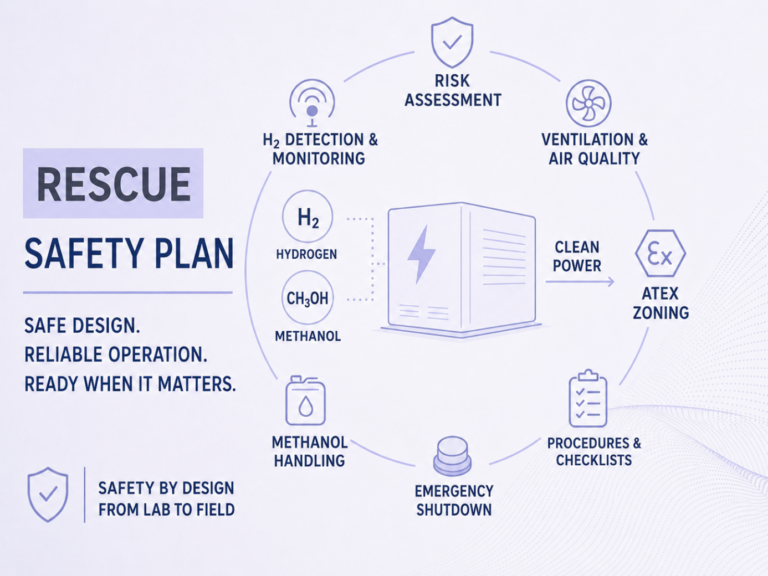
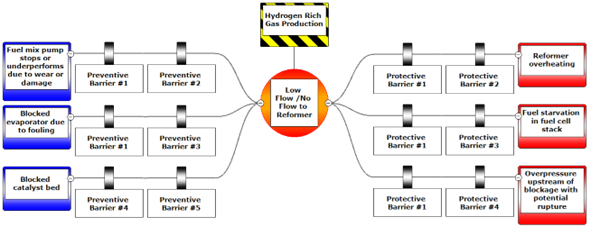
We support the consortium with the safety planning activities, hazard identification and risk assessment work around hydrogen, methanol and the fuel cell system. This includes studies such as Hazard Identification (HAZID), Hazard and Operability (HAZOP) and Bowtie analysis, as well as work related to Explosive Atmospheres (ATEX), emergency planning, management of change and training.
A key part of our contribution is also the certification pathway of the RESCUE system. We look at the applicable regulations, codes and standards, support the preparation of the required documentation, and follow the system through inspection, Factory Acceptance Test (FAT) and transport-related requirements. This is especially important because the system is not only a fuel cell unit in a lab; it is a containerised system that needs to be transported and operated safely in demanding emergency-response environments.
For us, RESCUE is interesting because it brings together innovation and real field use. Our contribution is to help the project move from a good technical concept to a system that is safe, certifiable and realistic to deploy.
How do you turn complex risk analyses into practical safety measures that work in the field?
We believe, that a risk analysis is useful only if it ends up changing something in the real system. Otherwise, it is just a report.
We usually start with structured methods like HAZID, HAZOP or Bowtie analysis to understand what can go wrong, why it can happen, and what the consequences could be. But the important step is what comes next: translating these findings into clear design requirements and operational controls.
That may mean adding a sensor, changing the logic of an emergency shutdown, defining ventilation requirements, improving access for maintenance, or writing a simple checklist for operators. We also try to avoid solutions that depend too much on someone “remembering the right thing” under pressure. In emergency applications, people may be tired, working fast, or dealing with many problems at once.
So the goal is to make safety as practical as possible: built into the design, visible to the operator, easy to inspect, and realistic for field conditions. A good safety measure is not the most complicated one; it is the one that works reliably when the system is actually being used.
Which concrete safety criteria or benchmarks must a system like the dual fuel HT-PEM technology meet before you would consider it ready for real-world deployment?
Before a system like this can be considered ready for deployment, we need to see that it behaves safely not only during normal operation, but also when something goes wrong.
Some key criteria are quite clear. The system must detect hydrogen or methanol leaks early, isolate the fuel supply, and move to a safe state automatically. Ventilation must be adequate, hazardous areas must be properly assessed, and ignition sources must be controlled. The pressure equipment, fuel lines, electrical systems and control logic also need to comply with the relevant regulations and standards.
For a dual fuel system, fuel switching is especially important. The system must show that switching between hydrogen and methanol can be done in a controlled way, without unsafe mixtures, unexpected pressure conditions, or unclear operator actions.
We would also look at testing and validation: emergency shutdown tests, alarm tests, leak-tightness checks, functional testing of interlocks, documentation, training records, maintenance requirements and certification evidence. In simple terms, the system must prove that the safety concept is not just designed on paper, but verified in practice.
Imagine using the dual fuel HT-PEM system in a disaster zone: considering the on-site conditions, what are the first safety measures you would check and follow before operating the system?
In a disaster zone, the system must be deployable quickly, but not blindly. The first safety checks should be simple, fast and focused on the main risks.
Before start-up, we would first make sure that the unit is positioned as safely as possible for the specific site conditions: on stable ground, with sufficient ventilation, clear access for the operator, and away from the most exposed points of the incident area. In practice, this does not mean looking for a perfect environment, because in emergency response, that rarely exists. It means choosing the best available location and avoiding obvious avoidable risks.
Then we would confirm the basics: that the selected fuel connection is correct, there is no visible damage or obvious leakage, and the emergency stop remains accessible.
From there, most of the safety work should be supported by the system itself. Leak detection, ventilation status, alarms, interlocks and emergency shutdown functions should be integrated in the design and visible through the control system, so the operator does not need to perform a long manual inspection under pressure.
The key is to have a short pre-start check, clear indications from the system, and operators who know the basic actions: start, monitor, respond to alarm, and shut down if needed. In emergency conditions, safety measures must be practical and fast, otherwise they will not be followed when they are most needed.
Consortium
Funding
Project RESCUE with Grant Agreement number 101192169. Supported by Clean Hydrogen Partnership and its members. Co-funded by the European Union.
Please Note