Kick-off for End User Dialogue: Project RESCUE Welcomes its Advisory Board
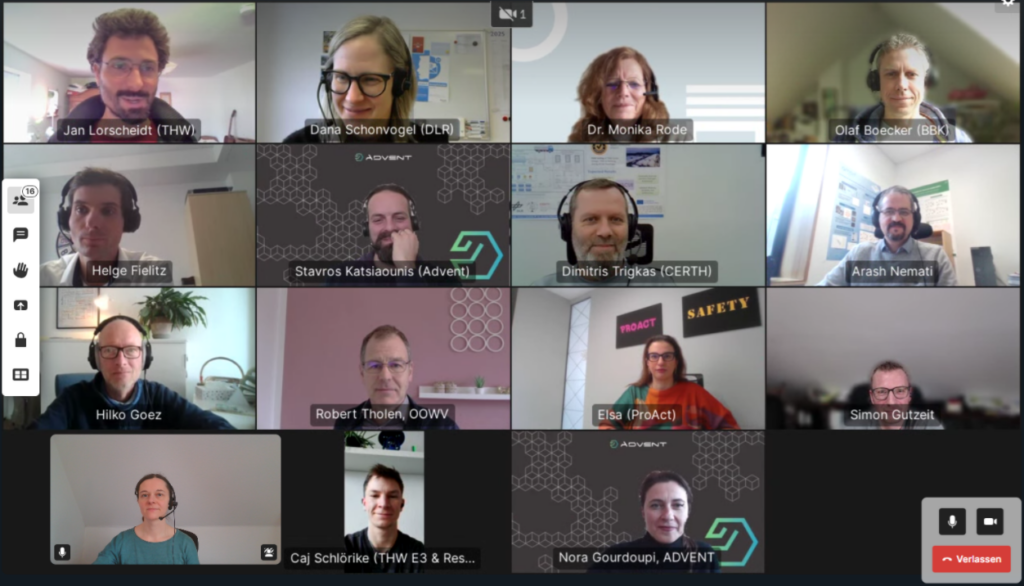
How do you make fuel cell technology fit for harsh demands of disaster relief? The answer lies in a partnership between research and application. In a virtual exchange meeting, RESCUE project partners have met with its newly formed Advisory Board for practice-oriented system field testing.
Goal of the project is to develop a dual-fuel HT-PEM power generator designed for the extreme conditions of disaster scenarios. However, technological innovation alone is not enough – in an emergency, the solution must be intuitive to operate, logistically integrable, and reliable.
Expertise from the Front Line of Rescue and Critical Infrastructure
To ensure that these requirements are incorporated into the development from the very beginning, the partners have secured the End User Advisory Board. We are delighted to be collaborating with following representatives:
Bundesamt für Bevölkerungsschutz und Katastrophenhilfe (BBK) (Federal Office of Civil Protection and Disaster Relief)
I.S.A.R. Germany (Relief organization for emergency aid worldwide)
Institut Der Feuerwehr NRW (IdF NRW, Fire Department Institute)
Oldenburgisch-Ostfriesischer Wasserverband (OOWV) (Germany‘s largest water supplier by area)
Johanniter-Unfall-Hilfe e.V. (Johanniter Accident Assistance)
From Laboratory to Real-World
During the meeting, the primary focus was on aligning theoretical performance data with real-world operational needs. This initial session was primarily dedicated to mutual introductions: the Advisory Board members presented the vital work of their respective organisations, while our team provided a comprehensive overview of the RESCUE project and its core objectives.
- Requirement Profiles: What physical and logistical conditions prevail at the scene of an emergency?
- Scenario Validation: What does the optimal testing ground look like for the planned 2,000-hour field test at the THW (Federal Agency for Technical Relief)?
- Fuel Management: What challenges arise regarding fuel switching and transport under real-world conditions?
Outlook:
This exchange has once again demonstrated that the acceptance of new technologies within the security sector grows only through continuous feedback from end-users. This dialogue will be deepened as early as June, when partners invite the Advisory Board to the next project meeting at the DLR in Oldenburg.
We would like to thank all participants for a constructive start and look forward to further collaboration in making the energy supply of the future crisis-proof.